The Shift from Search Engines to Answer Engines: Understanding the GEO Landscape
The digital landscape is undergoing a fundamental metamorphosis, moving away from the era of the "ten blue links" toward a more conversational, synthesized reality. For the seasoned specialist, the transition is clear: we are moving from a world of search engines to a world of answer engines. In the traditional paradigm, a user queries a keyword and navigates a list of results to find their own answer. Today, platforms like ChatGPT, Perplexity, and Google’s AI Overviews have fundamentally altered this behavior. Users no longer want to hunt for information; they want the information delivered, summarized, and synthesized. This shift creates a critical visibility gap. If your brand is not part of the data set that informs these generative responses, you are effectively invisible to a massive, growing segment of the market. This is the genesis of Generative Engine Optimization (GEO)—the strategic necessity of ensuring your brand is not just indexed, but understood and cited by the large language models (LLMs) that now act as the gatekeepers of information.SEO vs. GEO: Analyzing the Technical Divergence in Visibility Signals
While the two disciplines are often conflated, a rigorous analysis reveals a profound divergence in their technical requirements. Traditional SEO remains the bedrock of digital presence, focusing on ranking signals such as domain authority, backlink profiles, and keyword density to satisfy human-centric search engine results pages (SERPs). It is a game of competition for position. GEO, however, is a game of relevance and attribution within a probabilistic model. While SEO seeks to rank a page, GEO seeks to influence the training data and the retrieval-augmented generation (RAG) processes that allow an AI to confidently state that your brand is the solution to a user's problem. At AkOOre, our audits treat these as two distinct but complementary layers. We analyze how a page performs in classic search through technical health and keyword clusters, while simultaneously evaluating its "citability" for AI—checking if the content is structured in a way that an LLM can easily extract, summarize, and attribute back to your domain.The Mechanics of AI Citations: How LLMs Process and Recommend Brand Entities
To master GEO, one must understand that LLMs do not "search" in the way humans do; they predict the most likely next token based on patterns in their training data and the context provided. For a brand to be recommended, it must exist as a strong, coherent entity within the AI's semantic map. This requires more than just mentioning a product; it requires establishing a high degree of authority and factual consistency across the web. When an AI assistant like Claude or Gemini provides a recommendation, it is looking for high-confidence signals: authoritative statements, expert consensus, and clear, unambiguous data. This is why brand mentions and citations are the new currency. If your brand is mentioned in high-authority contexts and your technical signals—such as structured data—clearly define your expertise, you increase the mathematical probability that the AI will select your brand as the "correct" answer to a user's prompt.Optimizing for Conversational Discovery: Semantic Structure and Structured Data
The architecture of your content must evolve from a collection of pages into a network of modular, semantic blocks. Conversational AI thrives on clarity and directness. This is why GEO optimization emphasizes the use of clear, specific headlines, short summaries at the top of pages, and the heavy implementation of Schema markup. Structured data acts as a translator, providing the machine-readable context that allows an AI to instantly identify your price, your location, your reviews, or your technical specifications. We advocate for a "modular" content strategy: creating content that is easy to digest, highly factual, and structured around question-based natural language. By providing the answer directly and clearly within your content, you make it effortless for an AI to pull that specific block of information into its generated response, thereby securing your place in the conversation.Measuring the Unmeasurable: Tracking AI Share-of-Voice and Brand Mentions
One of the greatest challenges for the modern specialist is the "black box" nature of generative AI. Unlike traditional SEO, where you can track a specific keyword's position on a SERP, AI answers are dynamic, personalized, and often lack a direct URL to inspect. You cannot manage what you cannot see. This is why the industry is moving toward AI Share-of-Voice and brand mention tracking. Instead of looking at a single rank, we must look at the frequency and sentiment of your brand's appearance across various LLMs. How often is your brand mentioned when a user asks for a recommendation in your niche? Is the sentiment positive? Is the AI citing your specific website as the source? AkOOre addresses this by providing deep visibility into how your site performs across multiple AI assistants, moving beyond vanity metrics to provide a clear, data-driven view of your influence in the generative ecosystem.Integrating SEO and GEO: A Dual-Track Strategy for Maximum Digital Reach

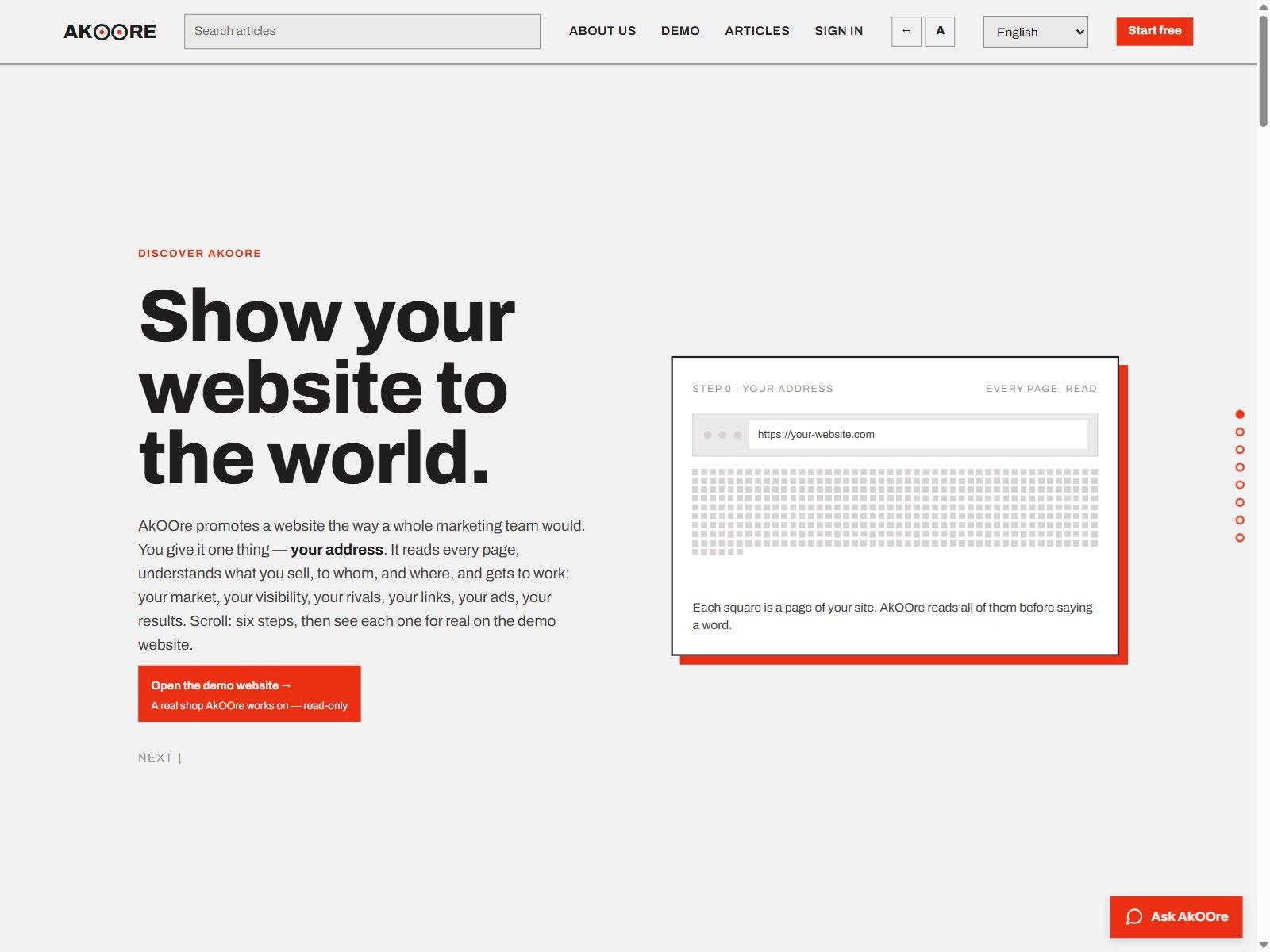
Discover AkOOre — the guided tour
See it for yourself on AkOOre's demo website, open to everyone: akoore.com/website_demo_welcome/