The Data Discrepancy Gap: Why GA4 Reporting Often Diverges from Business Reality
In the modern digital landscape, many marketers operate under the illusion of clarity, staring at clean, professional dashboards that suggest a seamless flow of user engagement. However, beneath the surface of a well-functioning Google Analytics 4 property, a silent divergence often exists between what the interface reports and what the bank account reflects. This is the fundamental tension of the modern analytics stack: your data can look perfectly right and still be fundamentally wrong. For the specialist, the realization that GA4 is not a single source of truth, but rather one perspective in a fragmented ecosystem, is the first step toward true measurement accuracy.
The discrepancy often stems from the very nature of how data is collected. According to research from Orbit Media Studios, GA4 can underreport traffic by as much as 11% for websites without cookie consent banners, and that number jumps to 20% for sites that implement them. This means a significant portion of your customer journey is essentially invisible, leaving a void in your data that no amount of dashboard monitoring can fill. When you rely on these incomplete snapshots to drive scaling decisions, you aren't optimizing; you are guessing with expensive consequences.
The Attribution Conflict: Decoding Discrepancies Between GA4, Ad Platforms, and CRM Data
The most common friction point in a marketing department is the debate over which channel deserves the credit. You might see Meta claiming 150 conversions, while Google Ads reports 120, and your CRM shows only 80 actual customers. This isn't necessarily a sign of error, but rather a symptom of conflicting attribution models and different conversion windows. Each platform operates within its own walled garden, using its own rules to claim credit for a sale. While GA4 attempts to provide a holistic view, it often struggles to reconcile the view-through conversions of display ads with the click-based reality of search marketing.
This fragmentation creates a dangerous environment for budget allocation. If a Facebook campaign shows a high ROAS in its native Ads Manager, the instinct is to double the spend. But if that campaign is merely capturing credit for users who would have converted via organic search anyway, you are effectively funding a redundancy rather than driving incremental growth. At AkOOre, we emphasize that measurement is not about finding a single "correct" number, but about understanding the relationship between these disparate data streams to identify where genuine, incremental revenue is actually being generated.
Technical Audit Framework: Validating Event Tracking, Conversion Logic, and Revenue Accuracy
To move beyond guesswork, a specialist must implement a rigorous technical audit of the event-based architecture that powers GA4. Unlike its predecessor, GA4 treats every interaction—a scroll, a click, a form submission—as an event. If these events are not standardized, your data becomes a fragmented mess of inconsistent naming conventions like button_name, btn_text, and cta_label. Such lack of discipline makes it impossible to build meaningful audiences or track the actual path to purchase.
A professional audit must verify that conversion events are tied to actual business outcomes rather than vanity metrics. For a B2B entity, a "page view" is noise; a "demo request" or "pricing page interaction" is a signal. We must also scrutinize the ecommerce implementation to ensure that revenue values are being passed accurately and that duplicate conversions—often caused by improper tag firing or page refreshes—are not inflating your perceived success. Without this granular validation, your analytics become a collection of high-signal noise that obscures the actual performance of your marketing operations.
The Impact of Consent and Privacy: Quantifying Data Loss from Cookie Banners and Ad Blockers
The era of seamless tracking has ended, replaced by a complex landscape of privacy regulations and user-controlled consent. The implementation of cookie consent banners, while essential for compliance, introduces a significant layer of data loss that must be accounted for in any strategic planning. When a user declines tracking, their entire session becomes a ghost in your reports, leading to a skewed understanding of user behavior and channel effectiveness.
Furthermore, the rise of ad blockers and browser-level restrictions means that even without consent issues, a portion of your traffic is inherently unmeasurable through traditional client-side tagging. This is why the role of the specialist is shifting from mere reporting to sophisticated data modeling. Understanding the gap between your "observed" data and your "actual" business outcomes requires a recognition that the data you see is only a subset of the reality occurring on your site. Acknowledging this loss is the only way to prevent the dangerous tendency to scale campaigns based on incomplete, underreported datasets.
Verification Protocols: Cross-Referencing GA4 with Marketing ROI and Sales Outcomes
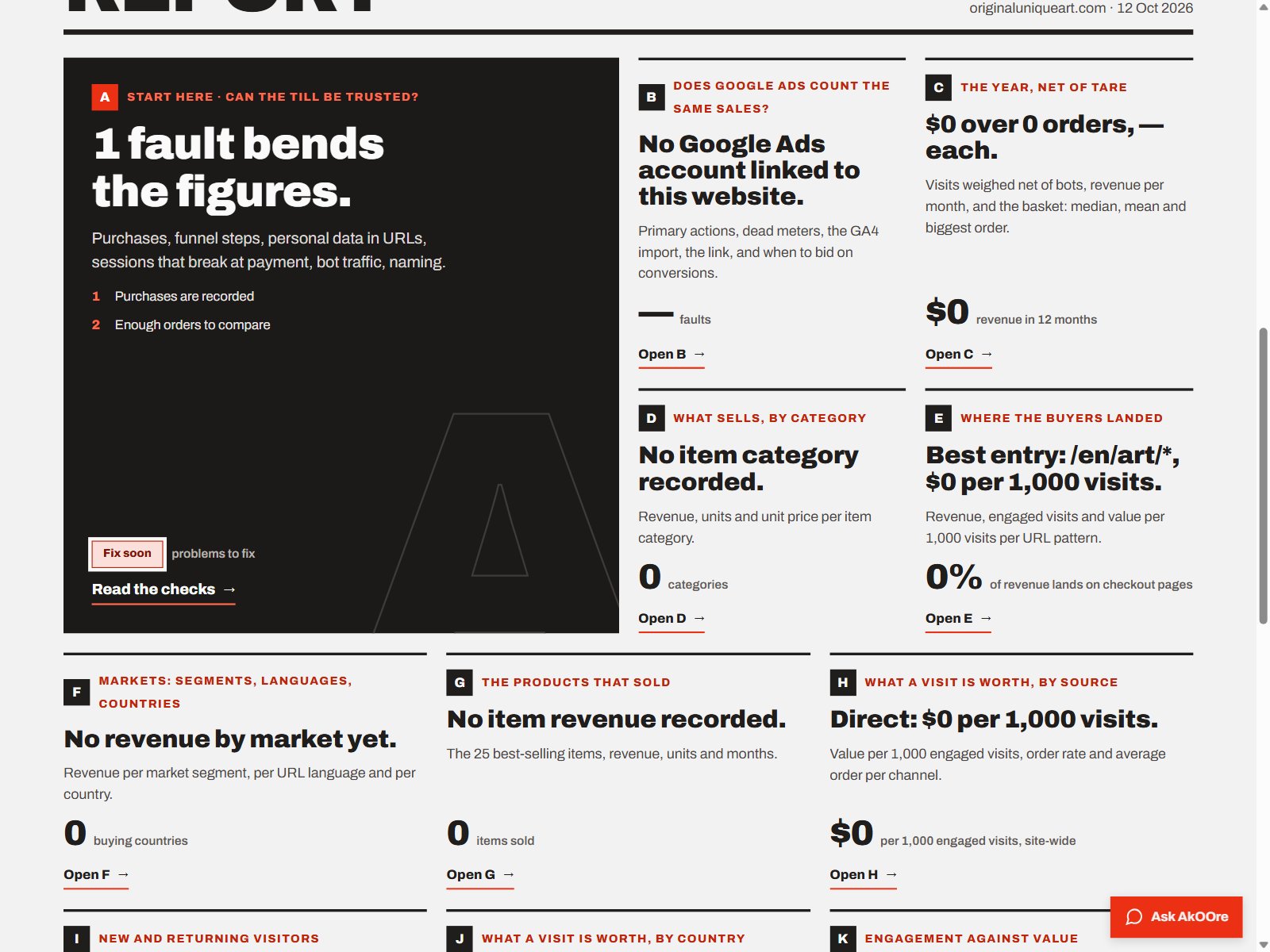
Google Analytics audit — OriginalUniqueArt.com — AkOOre
The ultimate litmus test for any analytics setup is its alignment with the bottom line. An audit is not complete until the data in GA4 has been cross-referenced against the "ground truth" of your CRM and internal sales reports. If GA4 reports 50 form submissions but your CRM only shows 38 new leads, there is a breakdown in the data pipeline that must be identified and repaired. This verification process is what separates a superficial dashboard from a high-performance measurement system.
At AkOOre, we believe in a system driven by measurable outcomes. Our approach to marketing operations is built on the principle that every action taken must be logged and its effect measured through concrete work and transparent reporting. For the SEO and GEO specialist, this means moving away from the "black box" of automated reporting and toward a structured, verifiable ledger of performance. By aligning your GA4 data with actual revenue, you transform your analytics from a source of debate into a powerful engine for growth, allowing you to scale with the confidence that your data reflects the reality of your business.
See it for yourself on AkOOre's demo website, open to everyone: akoore.com/website_google_analytic_audit/3/