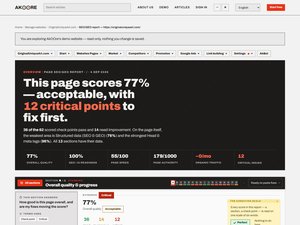
The Invisible Website Problem: Why Google Rankings No Longer Guarantee AI Visibility
For decades, the digital landscape operated under a simple, binary truth: if you were on Page 1 of Google, you existed. The metrics were clear, the path was paved, and the SEO specialist could point to a ranking and claim victory. But as we navigate the complexities of 2026, that fundamental truth has fractured. We are witnessing the rise of the Invisible Website Problem. This phenomenon occurs when a brand achieves high visibility in traditional search results but remains completely absent from the synthesized answers provided by AI assistants like ChatGPT, Claude, Gemini, and Perplexity. While your organic traffic might look stable on a standard dashboard, a significant and growing portion of the buyer's journey is shifting toward these conversational interfaces. When a user asks an AI for a recommendation, they aren't scrolling through a list of blue links; they are reading a curated, synthesized response. If your brand isn't part of that synthesis, you are effectively invisible to a massive, high-intent segment of the market, regardless of your traditional SEO prowess.
The Data Gap: Analyzing the Divergence Between Traditional SEO and GEO Performance
The divergence between Search Engine Optimization (SEO) and Generative Engine Optimization (GEO) is not merely a shift in terminology; it is a fundamental shift in how information is consumed and validated. Traditional SEO relies heavily on keyword density, backlink profiles, and technical site health to satisfy a crawler's algorithm. GEO, however, requires a different kind of authority. Generative engines do not just look for keywords; they look for answers. They seek out content that is clearly structured with logical hierarchies and, most importantly, content that directly addresses specific user questions rather than dancing around them with vague, jargon-heavy prose. The data shows a widening gap: websites that optimize for "topics" often fail to appear in AI responses because they lack the structured data and semantic depth required for an LLM to cite them as a definitive source. To bridge this gap, a specialist must move beyond simple ranking metrics and begin measuring AI visibility—the frequency and accuracy with which your brand is cited within generative responses.
The Risk of Optimization Spam: Navigating Google's 2026 AI Search Policies
As the industry rushed to capitalize on the "AI loophole," a cottage industry emerged, peddling tactics designed specifically to manipulate AI Overviews and generative responses. This included manufactured brand mentions and biased listicles engineered to trigger AI citations without providing actual user value. However, the era of "gaming the system" is closing. As of May 15, 2026, Google formally updated its Search spam policies to explicitly include generative AI responses. The directive is clear: techniques used to manipulate generative AI responses are treated with the same severity as traditional cloaking or link spam. Google’s automated systems and human reviewers are now actively looking for "scaled content abuse" and "inauthentic mentions" within AI-driven features like AI Overviews and AI Mode. For the sophisticated specialist, this means the old "growth hacks" are now liabilities. The only sustainable path forward is to build genuine authority through depth, accuracy, and consistent external references that confirm your credibility across the entire web.
The AkOOre Audit Framework: A Page-by-Page Breakdown of Technical and Generative Readiness
To navigate this dual-reality landscape, a holistic approach to auditing is no longer optional; it is a requirement for survival. AkOOre provides a specialized framework that analyzes your digital footprint page by page, looking through two distinct lenses. First, we examine the traditional technical health: site speed, crawlability, and internal linking structures. Second, we perform a deep dive into Generative Readiness. This involves auditing your content quality for semantic clarity, checking your Schema markup to ensure AI agents can parse your data, and evaluating your "answer-engine-readiness." We look at whether your pages provide the direct, authoritative answers that LLMs crave. This isn't about vanity metrics or "feeling" like you're ranking; it is about a rigorous, data-driven assessment of how well each individual page performs in both classic search engines and the emerging ecosystem of AI assistants. AkOOre's mission is to turn this complex analysis into a clear, actionable roadmap for growth.
From Search to Synthesis: Strategic Workflows for Dominating AI Overviews and LLM Citations
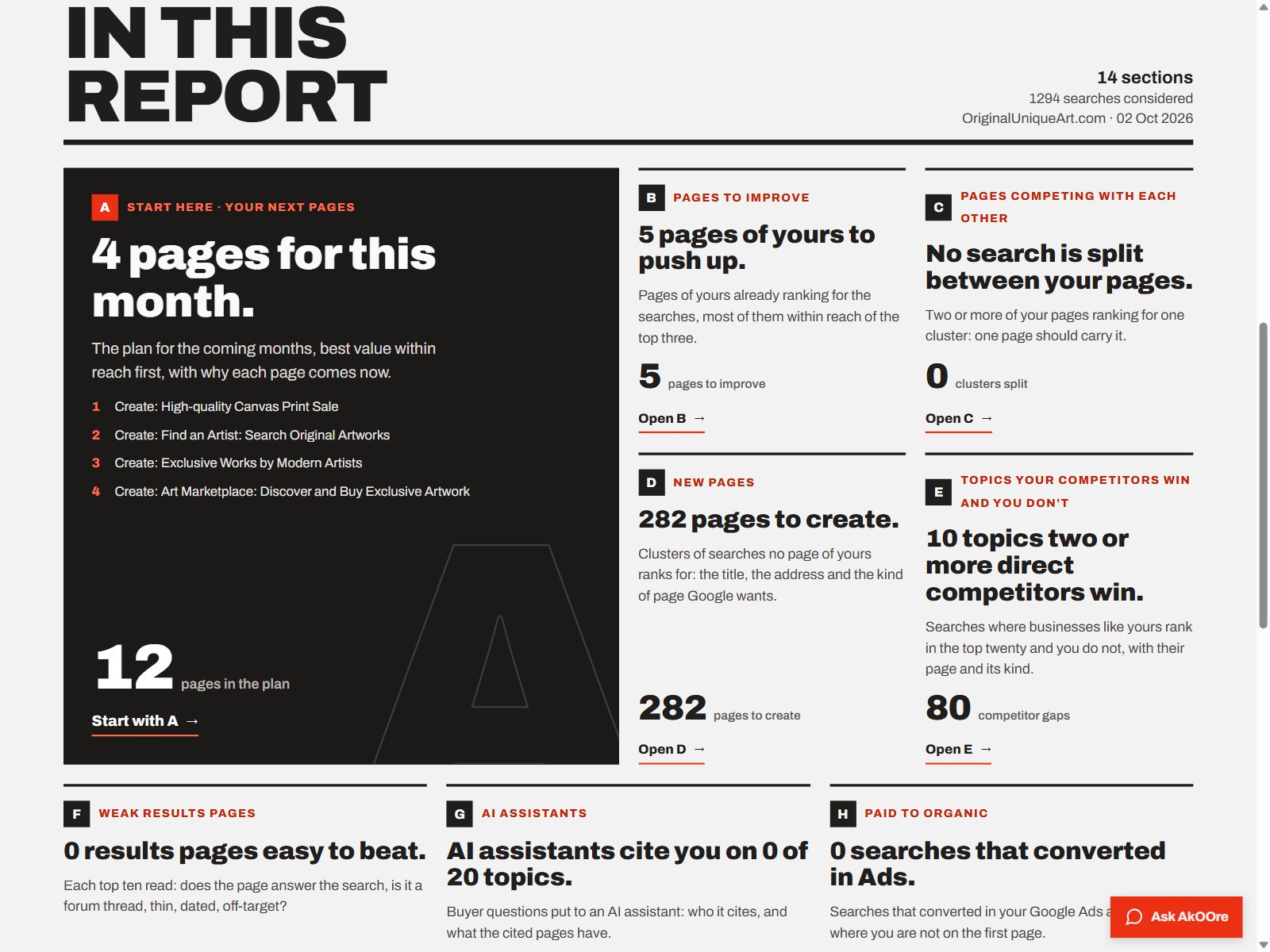
Pages Opportunities — OriginalUniqueArt.com — AkOOre
Dominating the future of search requires a strategic pivot from being a "source of information" to being a "source of truth." The goal is to move your brand from the periphery of a search result to the center of a generative synthesis. This requires a workflow that prioritizes authority through depth. Instead of creating fragmented, bite-sized content—a tactic Google has warned against—specialists must focus on comprehensive, well-structured content that demonstrates expertise through consistency and external validation. This involves a continuous loop of research, execution, and measurement. By connecting your website and marketing accounts to AkOOre, you move from guesswork to a managed operation. We help you build the keyword clusters that map to these new opportunities, execute backlink campaigns that raise your domain authority in the eyes of both Google and LLMs, and provide a transparent work ledger that shows exactly how your visibility is evolving. The transition from traditional search to AI synthesis is inevitable; the only question is whether your brand will be the one being cited, or the one being ignored.
Ready to stop guessing and start ranking? Visit AkOOre.com to see how we can automate your SEO and GEO operations with precision and data-driven results.
See it for yourself on AkOOre's demo website, open to everyone: akoore.com/website_pages_opportunities/3/