The Visibility Gap: Why Traditional SEO is No Longer Enough for AI-Driven Search
The digital landscape is undergoing a tectonic shift that most marketing teams are only beginning to grasp. For decades, the goal was simple: rank on the first page of Google, capture the click, and drive traffic to a landing page. But the era of the "blue link" is being superseded by the era of the "synthesized answer." Today, users are increasingly turning to AI assistants like ChatGPT, Claude, Gemini, and Perplexity to solve their problems. They aren't looking for a list of websites; they are looking for a single, definitive answer. This shift creates a profound visibility gap. If your content is designed only to satisfy a search engine's crawler but lacks the semantic structure for an LLM to extract, summarize, and cite, you are effectively invisible to the next generation of search. We are seeing a reality where, according to research from SparkToro, roughly 7 in 10 Google searches now end without a click. The journey no longer begins with a visit to your site; it begins with a conversation with an AI that may or may not mention your brand.The AkOOre Audit Framework: Deconstructing the 90 Checkpoints for URL Health
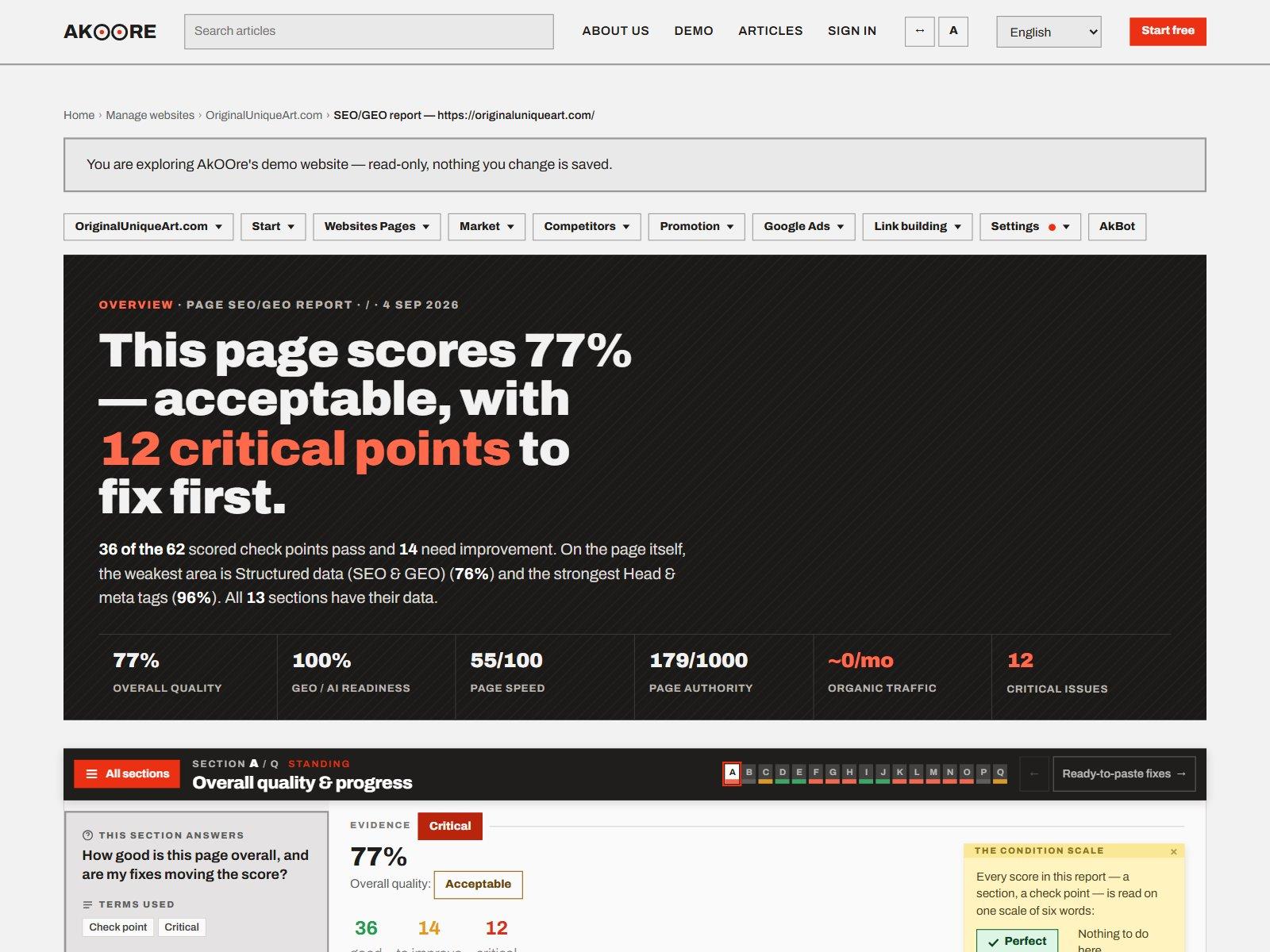
To navigate this new reality, a specialist needs more than just a standard SEO checklist; they need a diagnostic tool that understands the dual nature of modern discovery. AkOOre approaches this through a rigorous 90-checkpoint audit that examines every URL through two distinct lenses. First, we look at the traditional technical health—the speed, the crawlability, and the indexability that ensures Google's bots can find you. But the second lens is where the real work happens. We dive into the granular details of how a page is structured for machine reasoning. This involves analyzing the semantic hierarchy of your HTML, the clarity of your link text, and the presence of structured data that acts as a roadmap for AI agents. We don't deal in vanity metrics or "SEO hacks"; we provide a ledger of concrete technical requirements that transform a static webpage into a dynamic, highly-readable data source for generative engines.Technical GEO vs. Content GEO: Ensuring Your Data is Extractable and Quotable
A common mistake in the current market is treating Generative Engine Optimization (GEO) as a mere subset of content writing. In reality, it is a two-pronged discipline. Technical GEO is the foundation; it is the scaffolding that allows an AI to find and parse your content without getting lost in a "div-soup" of messy code. If your DOM is poorly structured or your headings are skipped, an AI agent will struggle to identify the core intent of your page. Once the technical foundation is set, Content GEO takes over. This is the art of making your expertise easily extractable. It requires publishing factually accurate, well-structured, and semantically relevant content that answers specific questions directly. It is about moving away from vague, keyword-stuffed prose and moving toward high-density, authoritative information that an LLM can confidently pull into a summary. You want your brand to be the "source of truth" that the AI cites when it provides an answer to a user's query.From Crawlability to Citation: How AkOOre Bridges the Gap Between Google and LLMs
The ultimate objective of any modern visibility strategy is to move from being merely "crawlable" to being "citable." AkOOre is designed to facilitate this transition by optimizing for the entire ecosystem. While traditional SEO focuses on earning a click, GEO focuses on earning a citation. This is a critical distinction. When an AI provides an answer, it looks for evidence, authority, and relevance. AkOOre's audits help you identify where your content lacks the "proof" required by LLMs—such as supporting claims with verifiable data or using clear, descriptive headings that define the context of your expertise. By bridging the gap between how Google indexes a page and how an AI summarizes it, we ensure your business is present in the "silent shortlists" that users form during their AI-driven research phase. We help you move from being a link in a list to being the authoritative source in a conversation.Measuring Success: Moving Beyond Rankings to AI Share of Model and Verifiable KPIs
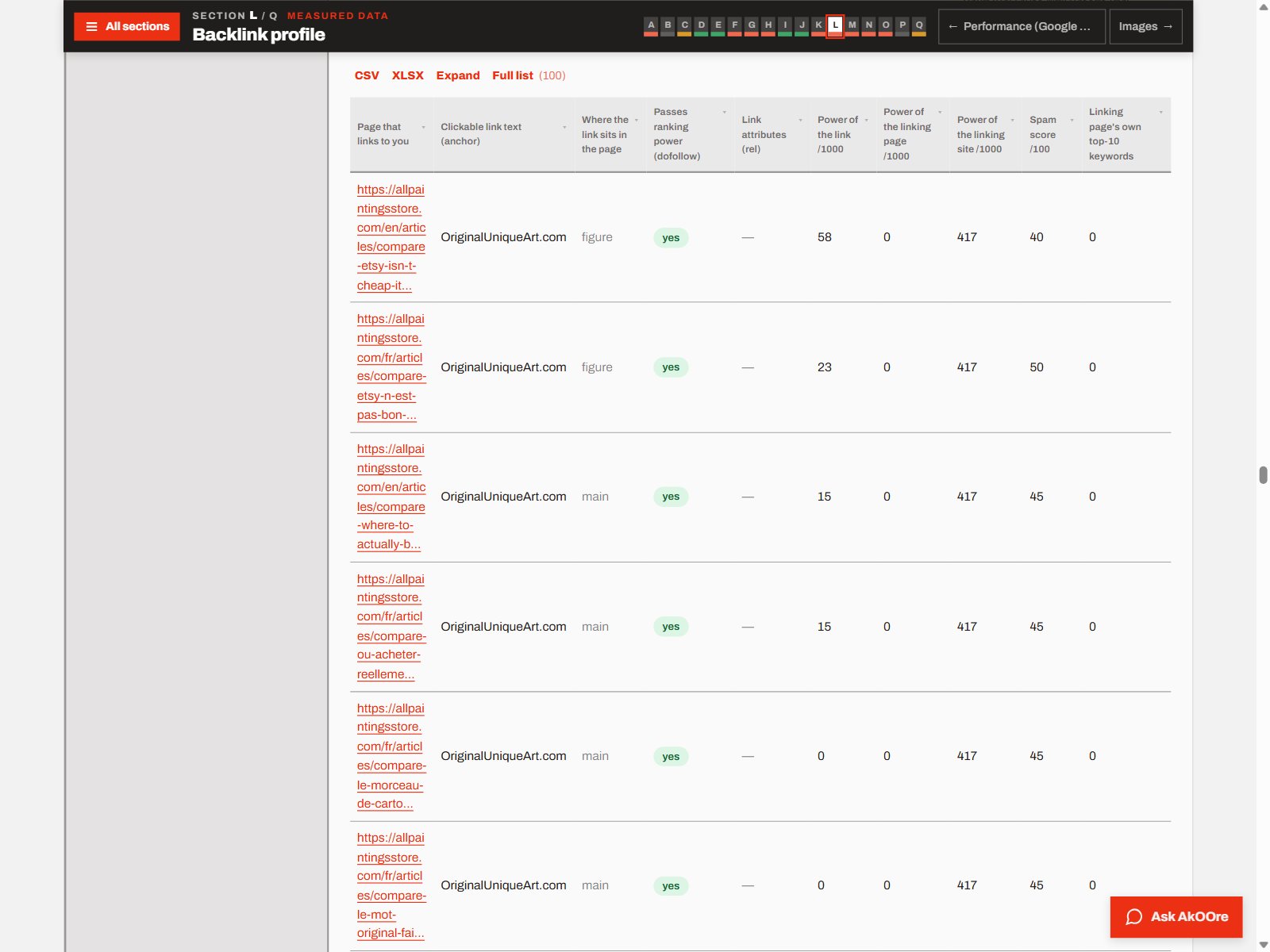
SEO/GEO report — https://originaluniqueart.com/ — AkOOre
See it for yourself on AkOOre's demo website, open to everyone: akoore.com/websitepage_seo_report/2496/