The Blind Spot: Why Traditional SEO Benchmarking Fails in the Age of Generative Engines
In the quiet, calculated world of digital growth, many specialists find themselves chasing ghosts. They spend weeks dissecting keyword volumes and tracking traditional SERP positions, only to find that their traffic remains stagnant despite "winning" the top spot on Google. This is the fundamental blind spot of modern marketing. We are witnessing a tectonic shift where the battlefield has expanded from the structured lists of search engines to the conversational, fluid responses of AI assistants. Traditional benchmarking focuses on who is ranking for what, but it fails to answer the most critical question of the current era: Who is being cited by the machines that are now making the decisions? When a user asks Perplexity or ChatGPT for a recommendation, the old rules of keyword density and backlink quantity are no longer sufficient. You are no longer just competing for a blue link; you are competing for the very essence of a machine's synthesized answer.Beyond Keywords: Mapping the Gap Between Search Rankings and AI Citations
To truly understand your position, you must look past the surface-level metrics that provide a false sense of security. A brand can dominate a high-volume keyword in Google and yet remain completely invisible to the generative engines that are reshaping consumer behavior. This gap is where most marketing budgets go to die. It is the difference between being a "search result" and being a "trusted source." While SEO focuses on the mechanics of indexing and authority, Generative Engine Optimization, or GEO, focuses on the mechanics of attribution and citation. If your content is not structured to be easily parsed, quoted, and credited by LLMs, you are effectively invisible to the next generation of search. The real intelligence lies in identifying the semantic distance between your content and the answers being generated by AI, ensuring your brand is not just a name in a list, but the definitive answer to a user's intent.The Intelligence Framework: Identifying Direct, Indirect, and Emerging GEO Competitors
A sophisticated competitor analysis requires a more nuanced taxonomy than simply looking at who sells the same product. To build a resilient strategy, we must categorize the landscape into three distinct tiers. First, there are the Direct Competitors—those who occupy the same space in the customer's mind and compete for the same immediate transaction. Then, we encounter the Indirect Competitors, the subtle disruptors who solve the same core problem through entirely different means, often bypassing traditional search entirely. Finally, and perhaps most dangerously, are the Emerging or Tertiary Competitors. These are the players who may not be your rivals today, but whose content is being ingested and synthesized by AI to provide alternative solutions to your audience. A specialist must map these entities not just by their business model, but by their informational footprint—how much "authority weight" they carry within the training data and real-time retrieval systems of generative engines.Data-Driven Counter-Strategies: Turning Competitor Backlink Profiles into Your Roadmap
Once the rivals are identified, the focus shifts from observation to exploitation. A competitor's backlink profile is more than a list of referring domains; it is a blueprint of their authority and a map of their digital influence. By analyzing the specific types of domains and the semantic context in which your rivals are mentioned, you can uncover the exact pathways they used to climb the rankings. This is not about mindless replication; it is about identifying the quality gaps. Where are they over-invested? Where are they neglecting structured data that could make them more "quotable" for AI? By dissecting their link-building patterns, you can identify high-value opportunities to secure your own authority, ensuring that your domain becomes a cornerstone of the digital ecosystem that both search engines and generative models rely upon for truth.The AkOOre Audit: Verifying Competitor Visibility in the Work Ledger and KPI Dashboard
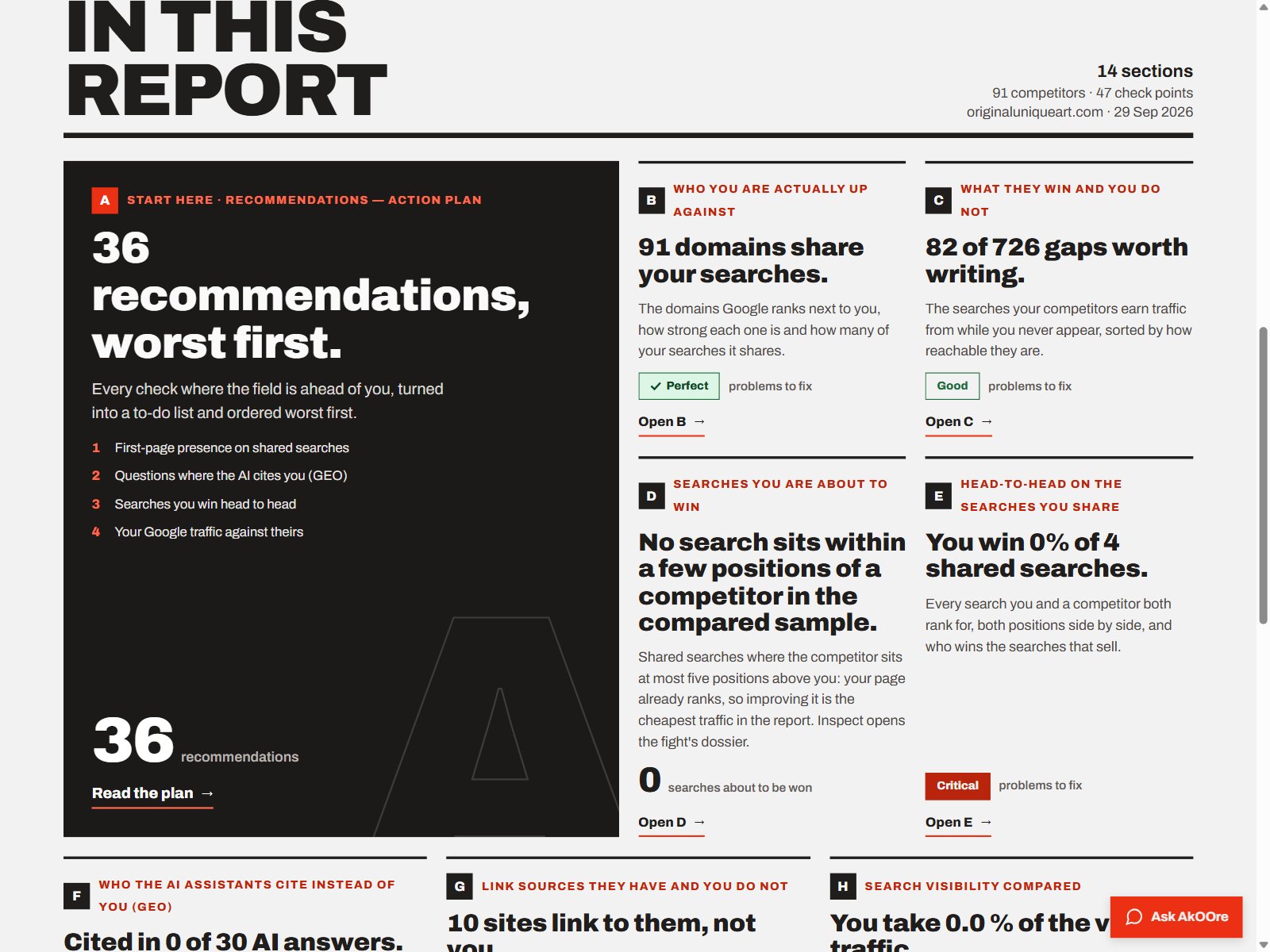
Competitor report — OriginalUniqueArt.com — AkOOre
See it for yourself on AkOOre's demo website, open to everyone: akoore.com/competitor_report/3/