The Information Graph: Why Wikipedia is the Backbone of LLM Knowledge Bases
In the shifting landscape of digital discovery, the traditional blue link is losing its monopoly to the synthesized answer. As search evolves into an interface of conversation, the underlying architecture of truth has become the primary battlefield for brand visibility. We are witnessing a fundamental transition where Large Language Models (LLMs) like ChatGPT, Claude, and Gemini do not merely browse the web; they ingest it. At the heart of this massive ingestion lies Wikipedia. It serves as the foundational knowledge base for the modern information graph, acting as the authoritative source that feeds the training data and real-time retrieval mechanisms of generative engines. When an AI assistant provides a definitive answer, it is often drawing from the semantic connections established within the Wikipedia ecosystem. For the SEO and GEO specialist, this means that understanding the relationship between your brand and the wiki-graph is no longer a niche pursuit—it is the cornerstone of modern authority.The Dead Link Opportunity: Turning Broken Wiki Citations into GEO Authority
There is a profound, often overlooked opportunity hidden within the digital decay of the web: the Wikipedia dead link. As the internet evolves, older citations within Wikipedia frequently become broken, leading to 404 errors or redirects. While a traditional SEO might see a dead link as a minor technical nuisance, a GEO strategist recognizes it as a high-intent vacancy in the information graph. When a link is removed or becomes broken, the semantic connection between a topic and a source is severed, creating a "knowledge gap" that generative engines can detect. By identifying these abandoned citations and replacing them with high-authority, relevant content from your own domain, you are not just performing link building; you are actively repairing the knowledge graph. You are positioning your brand to be the new, verified answer that an AI engine selects when it seeks to fill a void in its training data or real-time search results.Beyond Nofollow: How Ahrefs and Generative Engines Map Wikipedia's Influence
The debate over the value of Wikipedia links often stalls at the technicality of the nofollow attribute. Traditionalists argue that because Wikipedia does not pass "dofollow" PageRank, the effort is wasted. However, this perspective is increasingly obsolete in the era of Generative Engine Optimization. Modern crawling technology, such as AhrefsBot, which visits billions of pages every 24 hours, tracks these links regardless of their follow/nofollow status. These tools recognize the massive authority and topical relevance that Wikipedia carries. More importantly, generative engines do not care about PageRank in the classical sense; they care about contextual authority and entity association. When your brand is cited within a Wikipedia article, you are being mapped into the semantic web as a verified entity. This association is what drives your inclusion in AI-generated responses, making the "nofollow" distinction secondary to the massive signal of topical relevance you gain.The GEO Strategy: Reclaiming Authority in the Age of AI-Generated Answers
As the zero-click rate climbs—reaching as high as 64.82% in some Google search segments—the goal of marketing has shifted from earning the click to earning the citation. In the GEO era, you are no longer competing for position one in a list of results; you are competing for inclusion within a synthesized answer. This requires a strategic pivot toward structured data, clear attribution, and high-density factual content. To win in this environment, your content must be "quotable." It must provide the specific, verifiable facts that an LLM needs to construct a coherent response. This is the essence of Generative Engine Optimization: ensuring that when a user asks a complex question, your brand is the data point the AI selects to build its answer. It is a move from being a destination to being a fundamental component of the answer itself.Measuring Success: Integrating Wikipedia Signals into Your AkOOre Audit
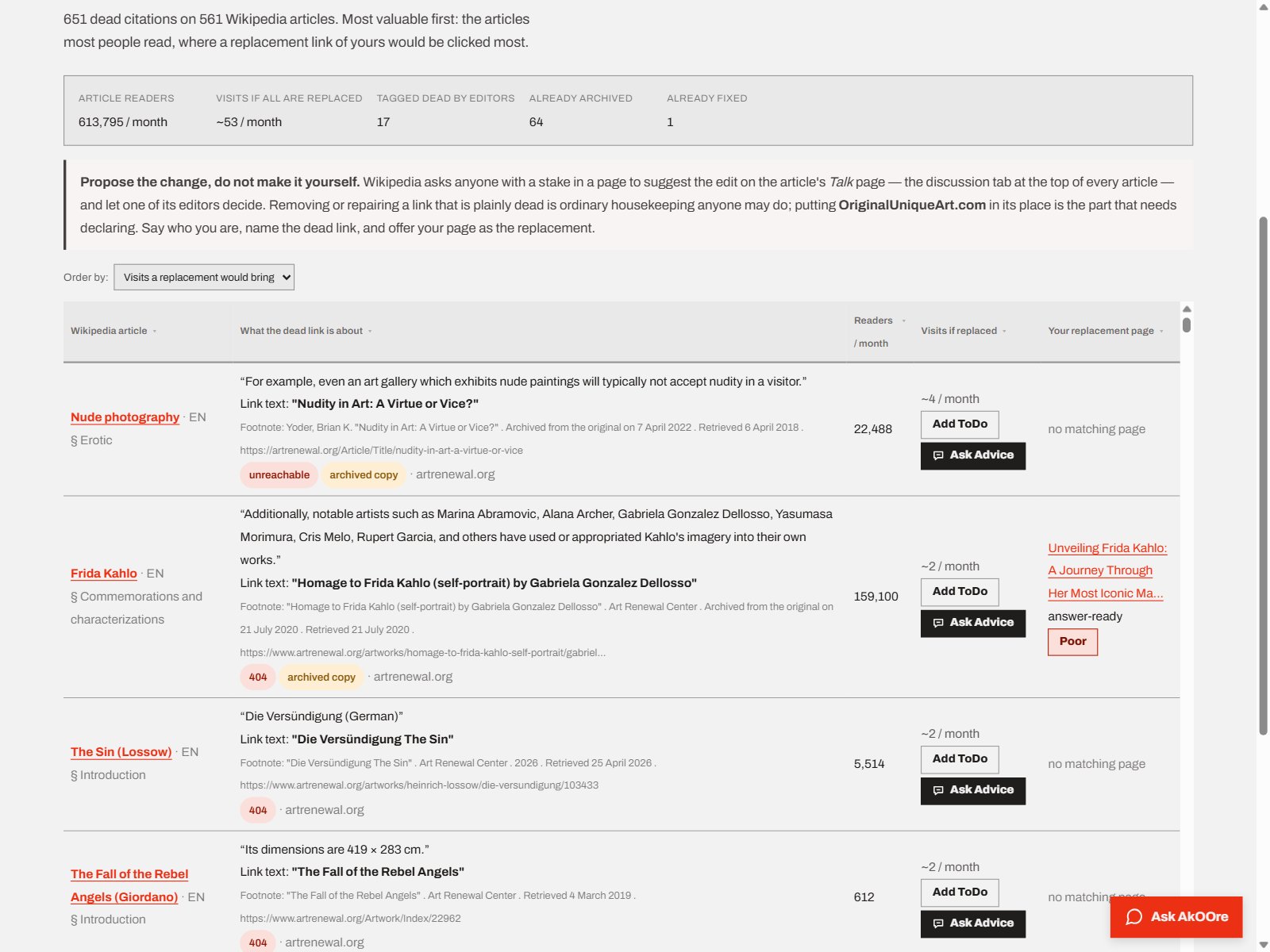
Wikipedia links to dead domains found — OriginalUniqueArt.com — AkOOre
See it for yourself on AkOOre's demo website, open to everyone: akoore.com/wikipedia_dead_links_found/3/