AkOOre.com F.A.Q. AI Crawlers & Your Visibility: Why Crawler Access is the Key to GEO and SEO Success
For the modern SEO and GEO specialist, the digital landscape is no longer a single, monolithic entity. We have moved past the era where a single successful crawl by Googlebot meant total dominance. Today, we face a fragmented reality where your visibility is split between traditional search engines and the burgeoning world of generative engines. The problem many specialists encounter is a "ghost presence": a website that ranks perfectly on Google but is completely invisible when a user asks Perplexity or ChatGPT for a recommendation. This gap exists because your content might be indexed, but it isn't accessible to the specific bots that feed the Large Language Models (LLMs) powering the next generation of search.
At AkOOre.com, we see this technical debt everywhere. You might have high-quality, expert content, but if your robots.txt or server configurations are inadvertently blocking the new wave of AI crawlers, you are effectively invisible to the AI-driven consumer. AkOOre helps bridge this gap by auditing not just for classic SEO, but for the technical requirements of Generative Engine Optimization (GEO), ensuring your site is ready for both the old guard and the new AI-driven reality.
Check your robots.txt file for any "Disallow" rules targeting AI bots.
The Visibility Gap: Why Traditional Indexing No Longer Guarantees AI Presence
It is a common misconception that if you are in the Google index, you are ready for the AI era. This is a dangerous assumption for any specialist managing a client's digital footprint. Traditional SEO focuses on ranking within a list of links, whereas GEO focuses on being the source of truth within a synthesized answer. When an AI engine uses Retrieval-Augmented Generation (RAG), it doesn't just look for a keyword match; it looks for a reliable, structured, and easily extractable piece of information to build its response. If your site is technically sound for Google but lacks the semantic clarity or the specific crawler access required by AI agents, you will find yourself excluded from the very answers your customers are seeking.
The shift is fundamental: SEO is about being found in a list; GEO is about being cited in a conversation. If the AI cannot "read" your content to extract a specific fact, it will simply move to a competitor who has made their data more digestible for machine consumption.
Verify if your content is being cited in AI-generated summaries by testing specific industry queries in Perplexity or Gemini.
The Anatomy of AI Crawlers: Distinguishing Between Indexing Bots and LLM Training Bots
To master this new frontier, a specialist must understand that not all bots are created equal. We are currently navigating a dual-track system. On one hand, you have indexing crawlers like Googlebot or Bingbot, which catalog your site to serve traditional search results. On the other hand, we have a new, more aggressive class of AI training bots—such as OpenAI’s GPTBot or Anthropic’s ClaudeBot—which crawl the web to ingest data to train and improve the underlying models themselves. Furthermore, there is a third, highly critical category: user-agent bots like ChatGPT-User or Claude-SearchBot, which act in real-time to retrieve specific web content when a user asks a question. Understanding which bots to allow and which to restrict is a delicate balancing act between protecting your intellectual property and ensuring your brand is part of the AI's knowledge base.
AkOOre's technical audits analyze these specific interactions, helping you decide whether to permit training bots (to build long-term model awareness) or to prioritize real-time retrieval bots (to drive immediate traffic and citations).
Review your server logs to identify which specific AI user-agents are currently visiting your site.
Technical GEO: How Crawler Access and Structured Data Drive AI Citations
If crawler access is the door, then Structured Data is the key that unlocks the room. For a generative engine to cite your website, it needs to move beyond mere text; it needs context. This is where technical GEO becomes a specialized discipline. By implementing advanced Schema.org markup—such as FAQPage, HowTo, or Article with explicit author entities—you are essentially speaking the AI's native language. This reduces ambiguity and allows the model to confidently extract your data to answer a user's query. When an AI can clearly identify your "How-To" steps or your "Product" specifications through JSON-LD, the likelihood of your content being used as the foundational "grounding" for an AI response increases exponentially.
At AkOOre, we don't just look for broken links; we look for "semantic gaps"—places where your content is high-quality but lacks the machine-readable structure required to be a primary source for an LLM.
Run a Schema validation test on your most important landing pages to ensure all critical entities are defined.
The Risk of Exclusion: How Restrictive Robots.txt Rules Impact Generative Engine Visibility
There is a growing tension between security and visibility. Many enterprise brands, fearing that their proprietary research or high-value content will be used to train competitors' models, implement strict rules in their robots.txt. While this might protect your data from being used for training, it often has the unintended consequence of blocking the real-time retrieval bots that drive modern AI search. If you block the bots that ChatGPT uses to "browse the web," you are effectively opting out of the AI search economy. You may protect your content from being used to train a model, but you also ensure that when a user asks an AI assistant for a recommendation, your brand is never even considered as a source.
This is a strategic decision that requires more than just a technical fix; it requires a business-level understanding of how your brand's value is distributed between direct traffic and AI-driven citations.
Audit your robots.txt to ensure you aren't accidentally blocking "Search" bots while trying to block "Training" bots.
Measuring the Unmeasurable: Auditing Your Site's Accessibility for the AI Era
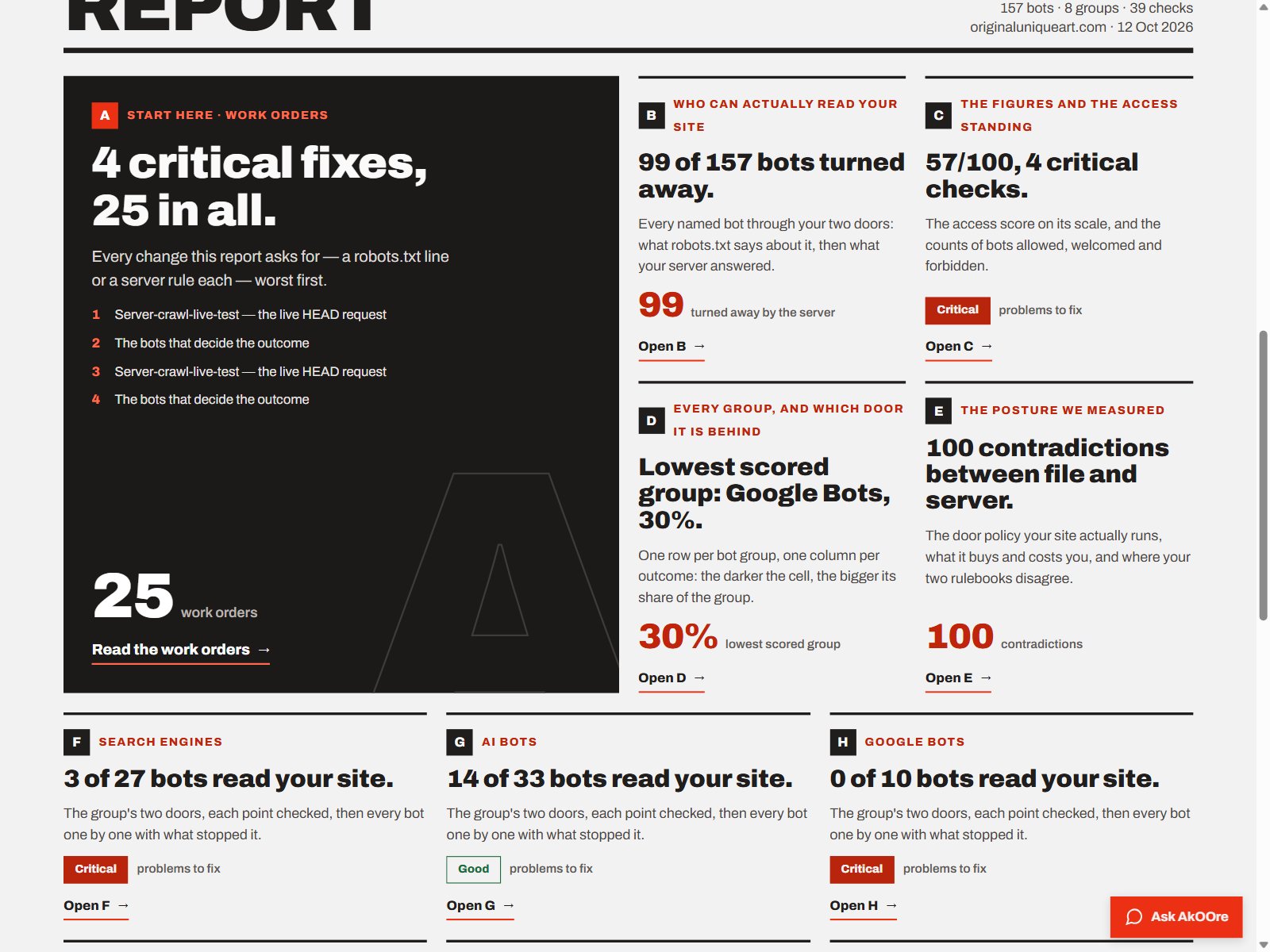
Crawler access — OriginalUniqueArt.com — AkOOre
How do you measure success in a world where the "search engine results page" is becoming a conversational dialogue? Traditional KPIs like organic click-through rate (CTR) are no longer sufficient. We must move toward a framework of AI Visibility. This involves monitoring brand mentions within LLM responses, tracking the frequency of your site being used as a citation in RAG-based answers, and analyzing the "citation gap" between your traditional rankings and your AI presence. It is about moving from guesswork to a data-driven understanding of how your content is being ingested and utilized by the machines that now act as the primary gatekeepers of information.
AkOOre provides the visibility you need through comprehensive audits that cover both the classic and the generative. We provide the numbers, the logs, and the actionable steps to ensure your website isn't just a collection of pages, but a vital, citable node in the global AI knowledge graph.
Demo: Explore the AkOOre dashboard and see how we measure your SEO and GEO performance.
See it for yourself on AkOOre's demo website, open to everyone: akoore.com/website_crawler_access_report/3/